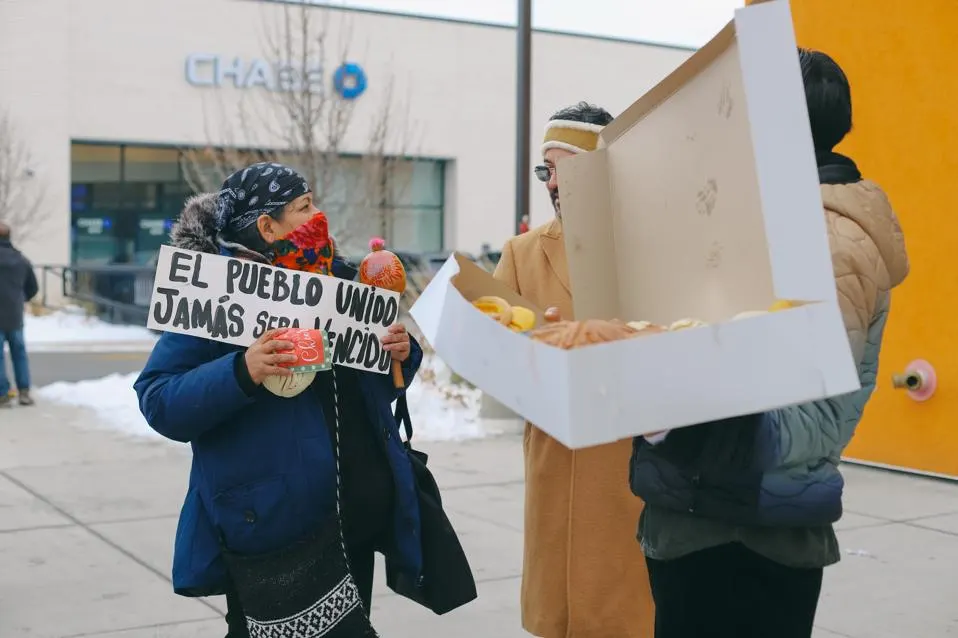
It’s a reality that Evelyn Flores, owner and co-founder of Alborada Quince is facing in real time. After 19 years in business in Little Village, she and her husband face uncertainty on the path forward. They expanded from a leased to owned space in late 2024, ahead of the latest wave of immigration raids. Meanwhile, their new property meant quadrupled monthly expenses, plus renovations and deposits. When raids hit in 2025, she recalls Little Village turned into a “ghost town.”
“The outdoor vendors weren’t there anymore,” she said. “We were getting phone calls of people canceling their events. People weren’t picking up their orders.”
As cancellations rose and business slowed, Flores found herself having to lay off employees. The biggest months for sales in the quinceañera industry run from January through May. In the thick of the season, her business is not back to normal.
While Aguilar is no stranger to the resilience of Latino-owned businesses, which was evident in the impact and recovery from COVID-19, the landscape looks quite different today.
“It’s bone chilling to me, and it’s a reality that we’re facing,” Aguilar said. “Right now I had conversations last week with over 15 businesses, one on one and shared that they were behind on rent.”
Aguilar said the possibility of vacancies is very high, an issue that 26th Street has not suffered from in recent years. She believes it’s these kinds of changes that could lead to increased joblessness and violence in the neighborhood. The economic impact, however, goes beyond the neighborhood lines.
“[Chicago is] known for 77 neighborhoods and the cultural diversity that we have as a city,” she said. “And I think that if those hubs start dying down, it’s definitely going to affect the economy of the city as a whole.”
Resilience and Solutions
Following the large exit of immigration enforcement out of Chicago mid-November, organizations, philanthropies and businesses responded with solutions to bring back foot traffic. For Day of the Dead, the Little Village Chamber of Commerce collaborated with more than 40 businesses to honor the holiday and promote specials. In December, more businesses joined in on a programming that featured a holiday trolley, making drop offs at designated businesses. On seeing the success of events, it’s something the chamber plans to replicate.
“We saw faces that we’ve never seen before, people that were coming here for this,” Aguilar said. “So I think that’s where we’re going. [We’re] creating more activities that focus on our businesses to bring foot traffic.”
Meanwhile, other local organizations supporting immigrant communities like Latinos Progresando are stepping in. Founder and CEO Luis Gutierrez said response has centered on providing resources addressing business owner needs: stability, visibility and revenue. These have included a series of approaches from know-your-rights webinars and technical resources, to shop local campaigns, and most recently a relief fund to help mitigate losses from recent raids.
“Latino entrepreneurs are incredibly resilient, but this is an extraordinary time,” he said. “Corporations and larger institutions are in a great position to be supportive. They can add local small businesses to their lists of preferred vendors, and tap into local businesses for company outings, for example.”
In recent commentary in the Brookings Institution, these community advocates also discuss local government as part of the solution to help businesses recover. Carmona highlighted how in October 2025 Los Angeles County declared a state of emergency as a reply to the financial fallout from raids. This made it possible for officials to establish legal aid, expedite hiring, and execute rent-relief funds. While Latino-owned businesses have limited federal programs to turn to for support across the country, Carmona has seen civic actors step up and encourage communities to shop local, owners dip into savings and expects entrepreneurs to turn to leveraging technology for creative solutions.
In Little Village, Aguilar hopes for longer term solutions as well and to turn the corridor into a landing place to be visited by all.
“We think that the answer is in driving, tourism, in driving different kinds of visitors to Little Village and making it the destination,” Aguilar said.
Referencing History to Understand Today
While Little Village hasn’t always been known for its Mexican population, it has been distinctly immigrant-made. It was originally settled by Czech, Polish, and other central European working class immigrants who labored in local factories after the Great Fire of 1871. When many existing immigrants began to move into the suburbs in the 1960s, often referred to as “white flight,” it made space for Mexican immigrants to move in as they had been displaced from other parts of the city due to urban renewal policies. By 2000, more than 90,000 people made their home in the area, with more than 80 percent Latino nearly half foreign-born, according to the Encyclopedia of Chicago.
“I know that a lot of people in like my generation, their parents arrived here around the same time, the ‘70s, ‘80s,” she said, “and a lot of our parents remember in the ‘80s too when immigration [enforcement] was running rampant on 26th street, and they would go into businesses, and they would go on to busses, they would go into factories.”
The history of immigration enforcement targeting working class Mexican immigrant communities in the Chicago area is documented as far as one hundred years ago. Ismael Cuevas, making his curatorial debut with the exhibit “Rieles y Raíces” at the National Museum of Mexican Art in Chicago, explores this moment in American history. Using community sourced materials, the exhibit documents how a first wave of Mexican immigrants in the 1920s, traqueros, were fundamental to building railroads in the Midwest. One of them was his great uncle. While these workers built one of the nation’s most lucrative businesses to date, Mexican workers lived in boxcars, the housing available to them. Cuevas references that Mexican immigrants like many immigrants of that era, were following the American Dream, and bought homes in redlined areas. At that point, national sentiment had begun to shift.
“By the 1930s, the Mexicans became a threat, and that’s when the first deportation campaign started,” Cuevas said.
The Mexican Repatriation drives of the 1930s led by local governments and officials saw the mass deportation of nearly two million people of Mexican descent to Mexico. Researchers estimated around 60 percent of these people were actually American citizens.
“I think something similar is going to happen where we’re going to become bigger in activism,” Aguilar said. “The only thing we can do is protect ourselves, help each other and speak out, continue to speak out, and just work together.”

 English
  Español de México